
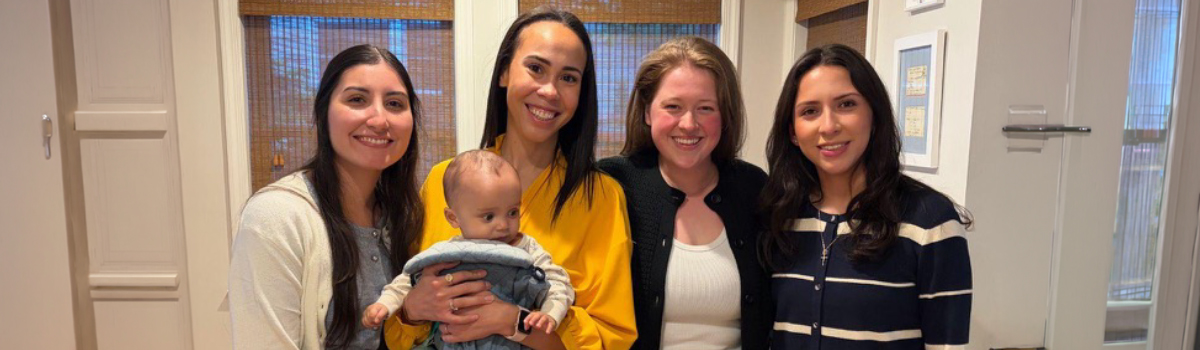
 From L to R: Stephanie Villalobos, Lara McLeod with son, Paxton, Zoe Manson, and Lisa Salas
In immigration law, the path to justice is rarely a sprint; more often, it is a marathon that spans years, requiring a baton to be passed from one semester of law students to the next. Last month, Catholic Law’s Immigrant & Refugee Advocacy Clinic (IRAC) celebrated a milestone that was nearly a decade in the making—a testament to the power of clinical education and the enduring bond between advocates and their clients.
The First Victory: Securing Legal Status
The journey began more than 9 years ago when a woman fled torture and persecution in her home country in Africa and arrived in the United States seeking safety. She had to make the heart-wrenching decision to leave her three young children behind, hoping to quickly win asylum and bring them to safety in the U.S. Unable to afford legal representation, she applied for asylum unrepresented. Unfortunately, her case ended up in the staggering backlog of an estimated 170,000 cases awaiting interviews at the Arlington Asylum Office.
For the students who first took her case in January 2024, the goal was clear but daunting: prepare a strong set of supporting documents and legal arguments. Then, navigate the staggering backlog to secure an interview. Through meticulous fact-finding and trauma-informed lawyering, those initial student advocates—now practicing attorneys—built the foundation of her claim. Their hard work culminated in a successful asylum grant, providing their client with the legal safety she needed to build a life in the U.S. without the fear of deportation.
The Second Chapter: Family Unity
However, for our client, safety was bittersweet. While she was protected, her three children remained thousands of miles away. As students involved in the case, including Lisa Salas '25 and Zoe Manson '25, graduated and moved into their careers, a new group of clinic students took up the cause, Stephanie Villalobos (3L) and then Lara McLeod (4E), who became a first time mother while working on the case.
The legal hurdles were significant, yet through tireless advocacy and commitment, the clinic helped secure approval for the three children–now young adults–to travel to the United States to reunite with their mother.
“Working on this case was one of the most meaningful experiences of my law school career…. This experience made me cherish the privilege of standing beside, and advocating for, clients navigating the complex immigration legal framework, and I'm excited to seek out roles in the future where I can continue doing that work.” Lara McLeod said.
A Seat at the Table
The years of paperwork, stressful meetings, and legal arguments culminated in a moment that transcended the courtroom. Last month, the client and her three children—now reunited on American soil—joined current clinic students Villalobos and McLeod (and her infant son!) as well as their alumni predecessors, Salas and Manson, for a celebratory dinner at the home of their supervising professor, Jocelyn Dyer. The Director of the law school’s Families and the Law Clinic, Erin Scheick, also attended.
As the family shared a meal with the students who had fought for them through multiple phases of the case, the evening served as a poignant reminder of why clinical programs exist.
"This is the heart of clinical work," Jocelyn Dyer, Director of IRAC, remarked. "Our students not only learn the substantive law, but also have the opportunity to impact the lives of real clients. In my clinic, they learn that persistence is a legal strategy. Seeing this family together with my current and former students after years of separation was a really special moment.” Dyer reflected.
Impact Beyond the Case
For the alumni who returned for the celebration, the dinner was a chance to see the long-term fruit of their labor. For the current students, it was an inspiration as they prepare to graduate and pass their own cases to the next incoming class.
“Our client’s steadfast commitment to reuniting with her children and bringing them to safety shaped the way I understand client-centered advocacy.” McLeod said, who “felt the weight” of the client’s “fight to bring her children to safety in a deeply personal way” as a new mother herself.
McLeod reflected that celebrating the family’s reunification “alongside the former student attorneys who had helped carry this case forward was an unforgettable moment and a fantastic close to my law school experience.”
At Catholic Law, we are proud of our students' commitment to seeing justice through to the very end—no matter how many years it takes.