

The second workshop on the Nuremberg Principles opened with a warm welcome from Susanna Frederick Fischer, Associate Professor of Law, Director of the Comparative and International Law Institute, and Director of the International Human Rights Summer Law School Program in Rome, Italy. Fischer expressed gratitude to the event's organizers, contributors, and participants, including Professor Roman Petyur, Head of the International Relations Office, Taras Shevchenko National University of Kyiv, Ukraine, for their invaluable insights and collaboration.
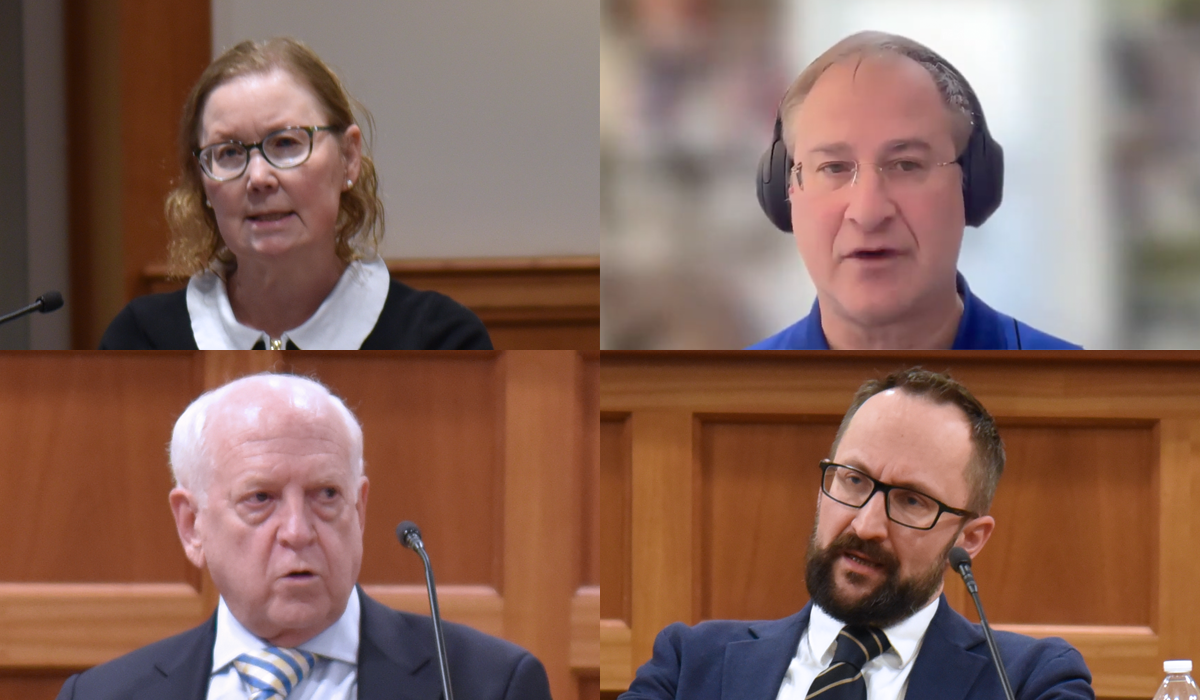 The event featured a panel of experts: Professor Piotr Szwedo, Associate Professor for Public International Law and Head of the Centre for Advanced Sustainability Studies at the Jagiellonian University in Kraków, Poland; Professor Orde Félix Kittrie, Distinguished Professor of Practice at the Sandra Day O’Connor School of Law, Arizona State University; and Professor Herbert R. Reginbogin, Collegiate Fellow of Law at The Catholic University of America and Professor of International Relations at Istanbul Kent University. Together, they explored the enduring relevance of the Nuremberg Principles in addressing modern challenges to international law and justice.
The panelists examined the intersection of the Nuremberg Principles with international economic and criminal justice institutions, reflecting on their historical roots in the post-World War II era. Discussions highlighted the role of institutions like the United Nations and Bretton Woods systems in fostering peace and stability through economic interdependence and legal frameworks. The conversation also addressed contemporary issues, such as the Russia-Ukraine war, the limitations of international dispute resolution bodies like the International Court of Justice and the International Criminal Court, and the challenges of enforcing accountability against powerful states. Panelists emphasized the need for global collaboration to counter the erosion of international legal norms, the rise of protectionism, and the exploitation of globalization.
The workshop concluded with a call to action, urging attendees to reflect on the principles of justice, accountability, and ethical governance. The panelists underscored the importance of integrating these principles into modern economic and legal systems to address pressing global challenges, from environmental concerns to the enforcement of international law. Attendees were encouraged to engage in ongoing discussions and contribute to reimagining global governance structures that uphold the ideals of the Nuremberg Principles in an increasingly complex world.
The workshops precede a two-day international conference, International Criminal Law 80 Years Later: The Crossroads of Law, Ethics, Religion and International Law, to be held at The Catholic University of America on April 12 and 13, 2027. The three workshops will provide students and faculty with the opportunity to discuss a wide range of interdisciplinary issues related to current challenges to international law, including the conflicts in Ukraine and Gaza, as well as American military intervention in Venezuela. The next workshop will be on Wednesday, March 25, 2026, at 12:30 p.m., both via Zoom and in person in the Slowinski Courtroom at The Catholic University of America, Columbus School of Law.
This workshop can be viewed below.